Friday, May 27, 2016

Restoring Bottomland Prairie: After the Burn, May 2016

Cutleaf Daisy (Engelmannia peristenia)
Native, perennial, volunteer.
Road Field Buffer
 Last year, I struggled for weeks to identify this beautiful yellow flower that volunteered in the Field Buffer along the driveway.  Once I learned what it was, and that it was out of its western-Kansas home range, I wasn't sure it would make it here.  Would it survive a Flint Hills burn and our wetter climate?   I told it, "If you come back next year, I'll remember you.  I'll know who you are next time.  I'll greet you by name!"   

What should I see this week but its sunny face!

So...
Hello, Cutleaf Daisy!  Welcome back!


Yellow Sweet Clover
(Melilotus officinalis)
Exotic biennial.  Volunteer.
I was not so happy to see something else in the Road Field Buffer--Yellow Sweet Clover, a native of Eurasia.   It out-competes other species in colonizing open ground, so it can be a problem in restorations.    

It looked as if it had formed a compact colony already--I thought I could spot-spray it without collateral damage.

But then I detected native plants interspersed with the clover.   

One of them was Canada Milkvetch!  
Canada Milkvetch (Astragalus canadensis)
Native perennial.  In Creek Field seed mix
but a volunteer here in the Road Field Buffer!
The Milkvetch appears between
Maximillian Sunflowers
and the Yellow Sweet Clover.

Canada Milkvetch was in our seedmix for the Creek Field, but not for the Road Field Buffer.  The seeds had to travel quite a way to put their roots down here.  
Yay, Canada Milkvetch!   You're a go-getter!  
A new Compass Plant
(Silphium laciniatum), native perennial,
volunteers in the Road Field Buffer,
 next o the Sweet Clover.  

Also interspersed with the clover was the new leaf of a Compass Plant.  

Nope!   We're not gonna spray.

There's too much good stuff mixed in with the clover.  We need the native plants to hold whatever ground we reclaim from the invasives.


The Milkvetch, Maximillian Sunflowers, and native
grasses can enjoy some extra space, now that
the Yellow Sweet Clover is gone.
But as it turned out, I didn't need to spray at all. This wet, wet spring had dampened the soil to the point that I could pull the Sweet Clover right out of the ground, root & all!


The roots of Sweet Clover
can be extensive!


Pretty soon I had liberated the native plants from their invasive neighbors.


And then, as a special treat,
I found a second Cutleaf Daisy!
A second Cutleaf Daisy blooms in the Field Buffer,
quite a distance west of the first.


Saturday, May 14, 2016

Restoring Bottomland Prairie: After the Burn, March-April 2016

The burn exposed
a network of runways
and tunnels.

The burn was excellent, removing the built-up thatch.  


Tunnels & holes
It temporarily exposed a  thriving metropolis, where so many creatures come and go!

Burrowers and tunnelers live here.


Burrows right after the burn
Some of the holes are the air holes of pocket gophers, who almost never surface; others are the homes of creatures that run about on the earth as well as take refuge in it.   


Same burrows in April
Some are back-up burrows for coyote parents who may need to move their babies in a hurry.  They may never be used, but smart coyotes (redundancy alert!) have them ready just in case.

Still others are the excavations of predators who have a taste for tunnel-dwellers!


End of March
At first, there's just a hint of green.

Woodland Sedge
(Carex blanda)
Volunteer
Bee Balm
(Monarda fistulosa)
In our seed mix


But overnight that green materializes into recognizable prairie plants. 
Canada Milkvetch
(Astragalus canadensis)
In our seed mix

Golden Alexander trying
to grow in a clump of
Eastern Gamagrass!
Both in our seed mix


Soon there is a field of clumps. 


And note:  The clumps are set off by bare earth.

In other words, the Hedge Parsley is gone!

The carpet of invasives that had  covered the field has been incinerated.

Question:  Can an early spring burn control for Hedge Parsley?

Answer, as of April 2016:  YES!!!

Wednesday, May 11, 2016

Restoring Bottomland Prairie, April 2016, Part 4: The Vetch Stretch, cont.--The Bad News


The bad news is that I found Crown Vetch in the Creek Field!  The burn revealed it, a circle about 20 yards in diameter, bright green in color.   The fire had gone right over it.   
Digging up a patch of
Crown Vetch left a temporary
bare spot in the Creek Field.

I tried digging it up the minute I saw it, but the ground was hard, and the clods hurt my hands.  However, it rained that night and the next, and after that I was able to reach down into the earth and pull up roots and rhizomes.  I was so frantic to do it that I didn't think to take a photo until the vetch was all gone (at left).
Crown Vetch re-sprouts next to
the flag that marks the spot
where Crown Vetch had
somehow hop-scotched 
into the Creek Field.

I flagged the spot, so I could find it for re-checking.

I did re-check a week later and found several tiny sprouts, which I quickly dug up.

Where had the Crown Vetch come from?

At no point had a patch of Crown Vetch in the buffer simply expanded until it crossed the path that separates the buffer from the field.  

However, seeds were another story.   Seeds could have been transported by wildlife or carried by wind or water.

And there was a seed source nearby--a patch of vetch on the buffer overlooking this part of the field.   Usually, land slopes down to a creek.  But Jerry Cameron, the previous owner, had thrown up a dike along this stretch of bank, so that the buffer sloped up.   Seeds on that spot could wash downward, toward the field.


I'm sitting on the ground, scooting
my way up the dike, digging vetch
as I go.  
Having been reconfigured by earth movers, the area was incredibly disturbed.   It used to be a Poison Hemlock forest, but after several years of control, it had become a Poison Hemlock savannah.   Large patches of Crown Vetch linked the toxic plants.  


I started at the bottom of the dike and worked my way upward, clearing the vetch as I went.

Oh, how I thanked the rains that made the digging easy!
Here a stone protects a Crown
Vetch caudex and covers up
the roots, making the plant harder
to dig out.    In the undisturbed parts of the
buffer, the soil goes deep
before it hits stones.  


However, the disturbance of the soil meant rocks near the surface, rocks that sometimes gave my hands an unpleasant scrape.  


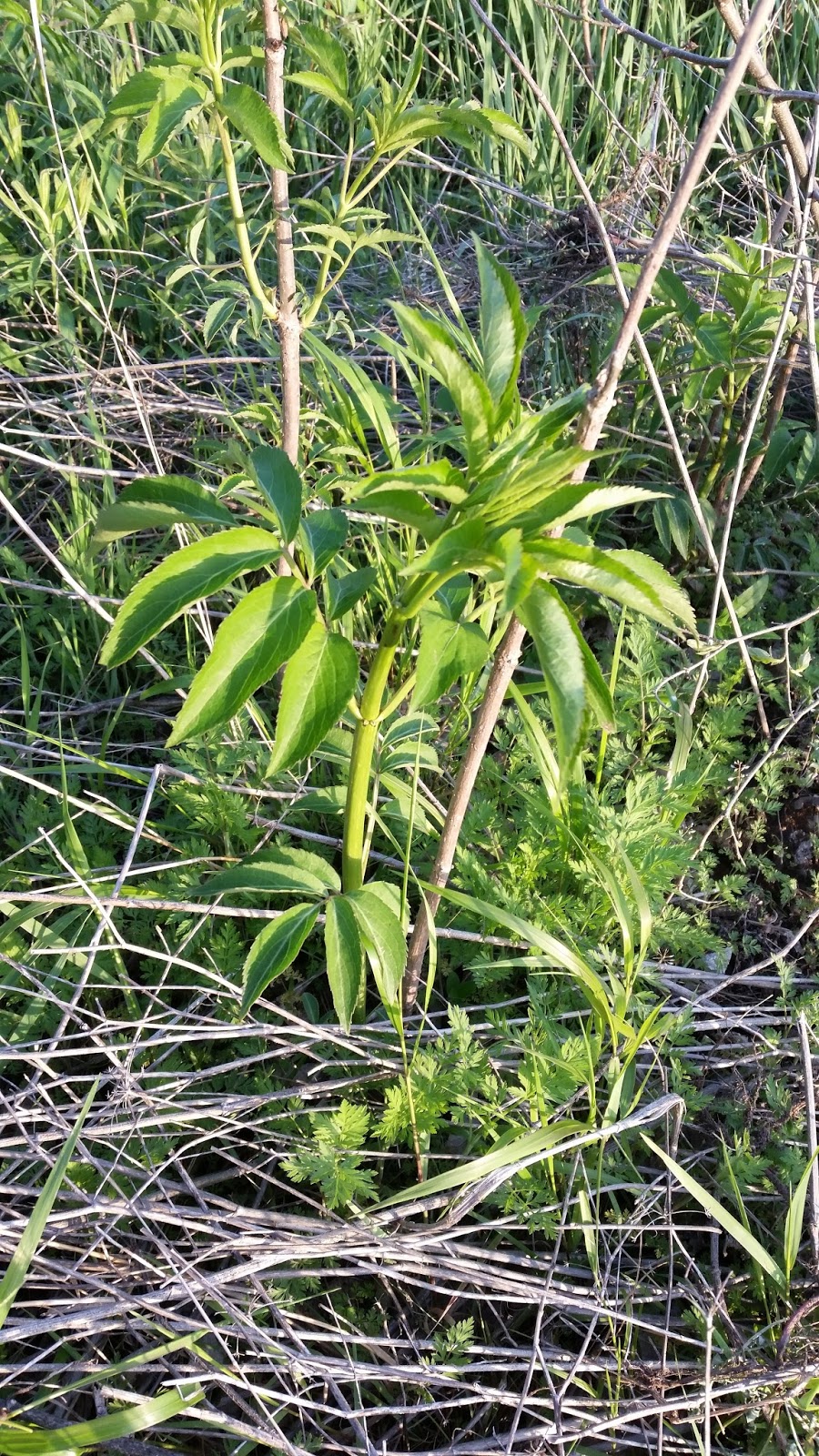
On top of the dike, an elderberry
seedling is surrounded by vetch.
This elderberry seedling has been
liberated from the vetch!


After several days, the built up dike
was cleared of vetch.  The green bunches
in the upper right are Poison Hemlock.
While I was clearing the Crown Vetch, the Poison Hemlock was greening up.   The photo at left, upper righthand corner, shows at least six hemlock clumps.


I will work on them another day.


Meanwhile, clearing the vetch off the dike will hopefully stop Crown Vetch seed-pods from raining down on the Creek Field.  

That's enough about bad news!

The good news is in the previous post, just below this one.


Monday, May 9, 2016

Restoring Bottomland Prairie, April 2016, Part 3: The Vetch Stretch, cont.--The Good News

The good news was that some beautiful native plants emerged where I had removed the Crown Vetch from the Creek Buffer.  
Wild Sweet William (Phlox divaricata)
Native perennial volunteer.
A little sanicle is sprouting in front
of this lovely phlox.
Native biennial volunteer.

Giant Hyssop (Agastache nepetoides).
This magnificent mint was
planted in the Creek Field but
decided to come up in the Creek Buffer.
Native perennial, in our seed mix.

 The Giant Hyssop at the left, the Wild Sweet William at the right, and the Canadian Wood- Nettle below would all love to form colonies of their own.   With the vetch pushed back, they can give it a try.


Canadian Wood-Nettle
(Laportea canadensis)
Native.  Perennial.  Volunteer.
It likes "rich, moist woods," so it's an honor
that it chose our buffer for its home!


Note the fat cheeks on the Canadian Wood-Nettle!  Its cousin, the Stinging Nettle, has a longer, narrower leaf. 

 Both nettles are food plants for Red Admiral caterpillars.  


Wild Violet (Viola nephrophylla) in the Creek Buffer.
Native.  Perennial.  Volunteer.
I took the photo just before digging out that last
vetch plant, visible in the foreground.

Among the other shade-lovers in the reclaimed territory were Wild Violet, Golden Alexander, White Avens,  White Snakeroot,  Sanicle, and Pennycress.
Golden Alexander
(Zizia aurea) Native perennial.
Planted in the Creek Field
Volunteer in the Creek Buffer

White Avens (Geum canadense)
Native,  perennial. volunteer.
These are the basal leaves.  The stem leaves will
look quite different, both in shape & shade of green.
Whie Snakeroot (Ageratina altissima=Eupatorium rugosum) 
Native.  Perennial.  Volunteer.


The shade-loving White Snakeroot (left) will bloom in the late summer. 

The unexplained corpse of an Ichneumon Wasp rests on the leaves.   


One of two sanicle species that
grow in Kansas.   Native.
Biennial.  Volunteer.
The sweet new leaves of Sanicle appeared just days after I had dug up the Crown Vetch from this very spot.  

You can still see the loose earth.

They say sanicles are healing herbs.  

They seem willing to help heal our bottomland!

Some of the species rushing to fill the void left by the departed vetch were non-native, such as the Field Pennycress pictured below.  
Field Pennycress
(Thlaspi arvense)
Introduced annual.
Volunteer.
Volunteer.


Other non-natives included Shepherd's Purse and Flannel Mullein. 

These species do not appear to push out other plants. 

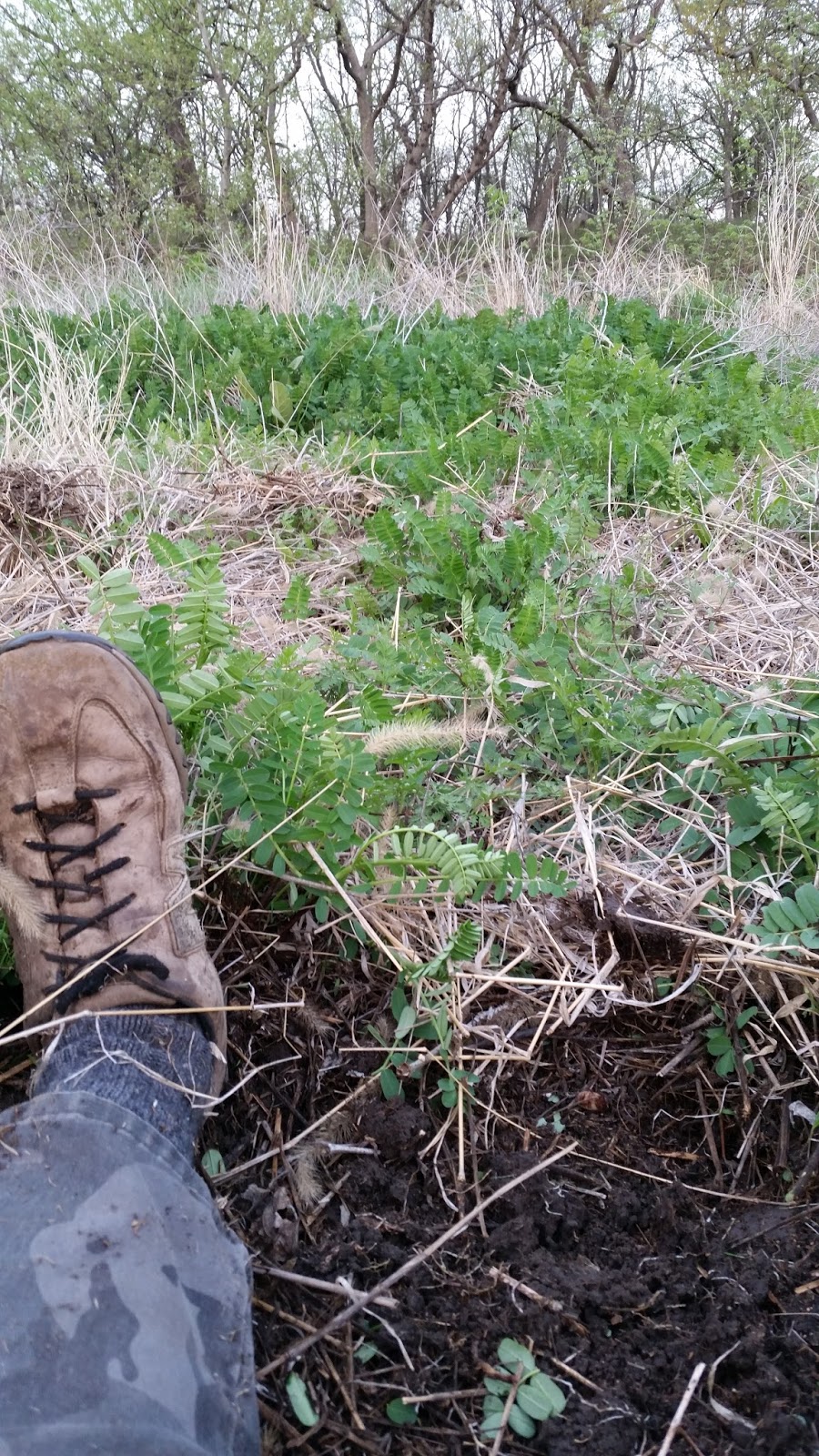
Absolutely thrilling to see was that while invasive vetch was moving from the buffer to the field, our native vetch, Canada Milkvetch, was moving from the field to the buffer!
Canada Milkvetch (Astralagus canadensis) growing on the edge
of the buffer, next to the Loop Path.  The hairs on leaf & stem
distinguish it from Crown Vetch.

Of course, Canada Milkvetch can look very much like Crown Vetch when it first comes up.   I have to be careful that I don't remove a good guy when I'm after bad guys!  The closeup on the right shows the hairs on leaf & stem that distinguish Canada Milkvetch from Crown Vetch.

That's enough good news.


For the bad news, see the next post!

Saturday, April 30, 2016

Restoring Bottomland Prairie, June 2015: Waves of White, Dots of Color

Driveway, looking east at sunset.
The Creek Field is on the left and
the Creek Buffer is on the right.

In June 2015, the Creek Field was a good place to watch the sunset in reverse.  
Creek Field, looking southeast,
with waves of white flowers in the foreground.


Hedge Parsley (Torilis arvensis) starting to bloom.
Annual.  Weedy volunteer.


Hedge Parsley, that  aggressive, non-native annual, appeared to cover every inch of the Creek Field.  It was a sea of green until it started to bloom--and then it was a sea of white.  


Swelling the waves were other white-flowered species:  Daisy Fleabane, Elderberry, Yarrow, and Foxglove Penstemon.
Daisy Fleabane
(Erigeron strigosus) 
Annual, Volunteer.
Yarrow (Achillea millefolium)
Perennial, Volunteer


Elderberry (Sambucus canadensis)
in the Creek Buffer
Perennial Shrub, Volunteer


Penstemon digitalis
Perennial, in our Seed Mix

Once again, the annual Hedge Parsley only seemed to dominate, as other species joined in.  In addition to the white flowers, splashes of color appeared in the sea of white.

For example, as this photo shows, the pink-lavender flowers of Bee Balm contrasted delicately with the white Fleabane in the foreground and the billowing Hedge Parsley flowers in the background.
Bee Balm (Monarda fistulosa)
Native perennial, in our Seed Mix,
with Daisy Fleabane in the foreground
and frothy waves of Hedge Parsley
flowers in the background.
Clasping Coneflower
Dracopsis amplexicaulis
Native annual,
 in our Seed Mix

One of the beautiful things about the early stages of a restoration is that annuals get to show their power!

Clasping Coneflower, an easily germinating annual, covered the Loop Path.

The leaf is the "clasping" part.
Dracopsis amplexicaulis leaf


Dracopsis amplexicaulis inflorescence.
The fringe of lovely dark marks on the yellow
ray flowers do not appear on every blossom.
Native annual.   In our seed mix.


Rudbeckia hirta
Black-eyed Susan.
Native biennial
or short-lived
perennial.  In our Seed Mix.
Dracopsis is one of the genera of "prairie coneflowers."  The other three are Rudbeckia, Echinacea, & Ratibida.   The Creek Field in  2015 hosted all four, with Dracopsis, Rudbeckia, and Echinacea blooming in June.    


Rudbeckia hirta inflorescence about to open.
"Hirta" means "hairy!"


Echinacea purpurea
A prairie coneflower.
Perennial
In our Seed Mix.


I have often thought that the "cones" of  coneflowers provide nice landing places for pollinators on windy days!


Eastern Gama Grass
Tripsacum dactyloides
Perennial
In our Seed Mix.


Eastern Gamagrass also bloomed in June.   Cattle like it so much it is grazed out of most pastures.   I like it so much I once wanted an entire field of nothing but Eastern Gama Grass.  

However, I am happier to have it as part of  a native polyculture.

Its flowers are gorgeous!

June was also the beginning for me of Sunflower Studies--a very tough course.   I spent a lot of time turning flowers upside down and pondering the bracts (modified leaves that sub-tend a flower cluster).   I learned that moisture-loving Sawtooth Sunflower had long stringy bracts, while edge-hugging False Sunflower had squat, pudgy bracts.  
Sawtooth Sunflower (Helianthus grosseserratus) has stringy bracts.   It seems always to have a wind-blown look as well.  Native perennial.   In our Seed Mix.  


False Sunflower.  Two things to look
for are the squat bracts that form a scalloped
cup and the inflorescence sitting atop a
long naked stem.
A katydid lands on the
disk florets of False
Sunflower (Heliopsis
helianthoides).
Native perennial.
In our Seed Mix.  


Other sunflowers came on the syllabus later in the summer!
I don't know if I passed the course.   I do know I'll be taking it again!


Common Milkweed  (Asclepias syriaca )
Native perennial.  Volunteer 
Easier to identify was the Common Milkweed that bloomed on the edges of the field.  Sullivant Milkweed was in our seed mix, but if it appeared in 2015, I missed it.  I'll be looking for it this year!  

The leaves of the Common Milkweed have stems, while those of Sullivant Milkweed are mostly stemless.   

Milkweeds are wonderful!

There was trouble in paradise, however.   Some Musk Thistles bloomed and set seed before we could remove them, and Crown Vetch continued to invade the Creek Buffer.   It also hop-scotched into the Creek Field.  We pushed both species back, but we know that was just one skirmish in a long war.
Musk Thistle blooming.
Carduus nutans is on the Kansas list of Noxious Weeds.
Non-native biennial.  Sneaky volunteer!


Crown Vetch (Coronilla varia).
Non-native perennial.
Aggressive volunteer.
Some butterflies don't  mind!


Gaillardia pulchella
Native annual.
In our seed mix.

Still, the beauty kept coming. 

The amazingly lovely Gaillardia continued to bloom throughout June.  

In the green sea with the white foam, the yellow-orange-brown Gaillardia joined many other multi-colored flowers bobbing on the waves!