Tuesday, July 12, 2016

Restoring Bottomland Prairie: June 2016 (after Burning in March)


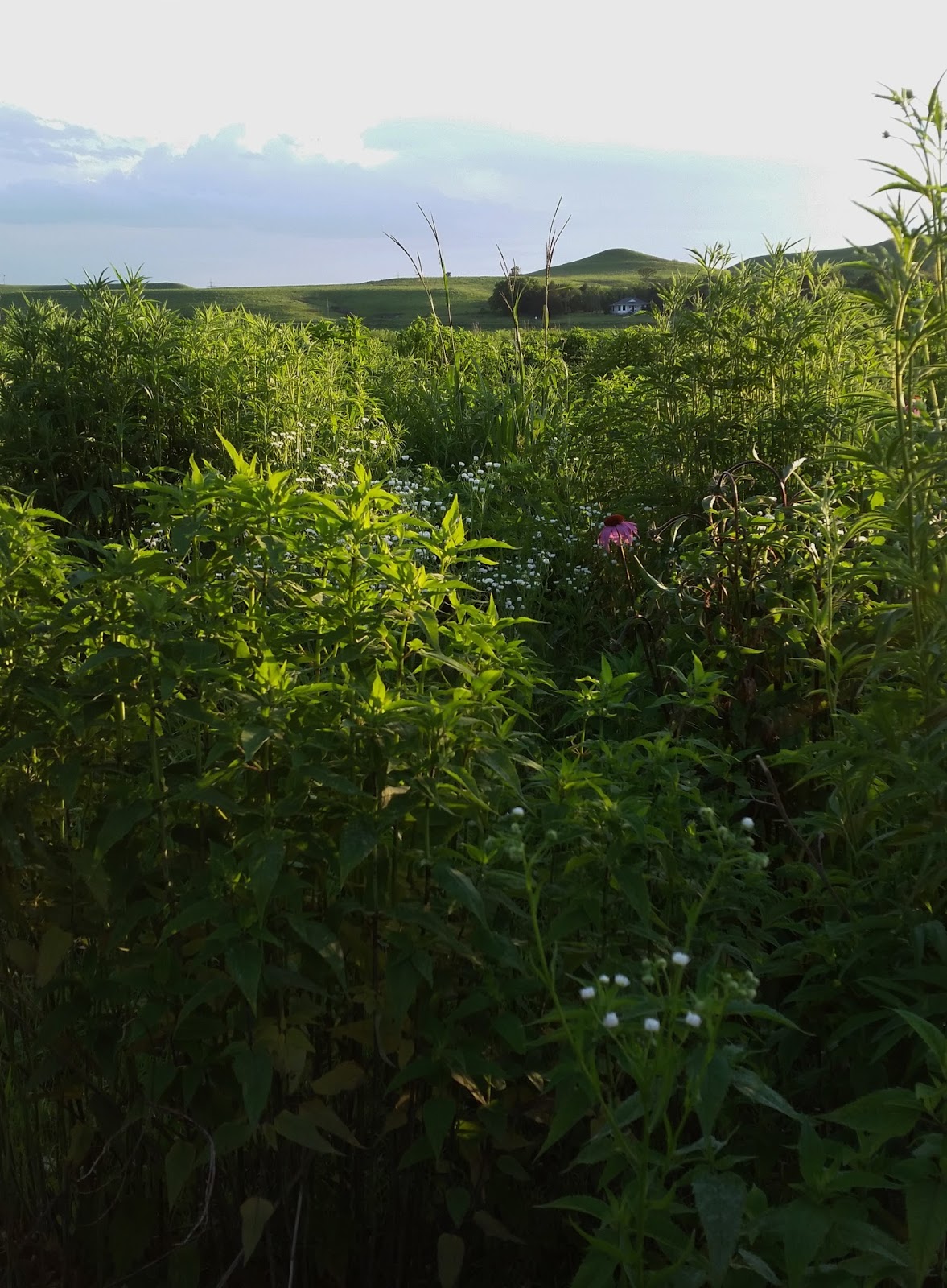
Overview of Creek Field, early June 2016, looking west
The white blossoms are Daisy Fleabane, not
Hedge Parsley; the lovely pink flower is Echinacea
purpurea.
I had to describe the Creek Field one year ago--in June 2015--as a "sea of white."  That was due to the Hedge Parsley, a weedy non-native annual, that blanketed the field with trillions of white flowers. 

The overview pictures here show that one year later, in early June 2016, the dominant color is green.   


Overview of Creek Field,
looking east, early June 2016.
That's Giant Ragweed in the
foreground.
Much of that hue was furnished by the native perennials that were in our seed mix--Bee Balm, Sawtooth Sunflower, Whole-leaf Rosinweed, Canada Milkvetch, False Sunflower, Eastern Gamagrass, & Canada Wildrye--all of which appeared in early June with hardy green growth.  To that growth was added a proliferation of the stems & leaves of volunteer native plants--Maximillian Sunflower, Gray-headed Coneflower, Jerusalem Artichoke, Goldenrod, Tall Thistle, Prickly Lettuce (Lactuca serriola), Horseweed (Conyza canadensis), Common Ragweed (Ambrosia artemisiifolia), and Giant Ragweed (Ambrosia trifida).   

 (I discuss in previous posts the non-native invasives--Musk Thistle, Crown Vetch, Poison Hemlock, and the Sweet Clovers-- which I also had to deal with in June.)

As June progressed, blossoms of various colors appeared amidst the lush green growth, as the different species began to bloom.   

Eastern Gamagrass bloomed luxuriantly!    It has an impressive, and to me improbable, reproductive structure.   It must work, as we have lots of Eastern Gamagrass--about twice as many flowering plants as last year.  


The little curved
worm-like structures hanging down toward the bottom of the
inflorescence are the female flowers.  The purple cones hanging
from white stems further up are the male flowers!


Big-flower Coreopsis, Indian Blanket Flower, and Purple Coneflowers all bloomed in early June.


Large-flowered Coreopsis
(Coreopsis grandiflora)
Native perennial.  In our seed mix.
Blanket Flower (Gaillardia pulchella)
Native annual.   In our seed mix.
Behind the Gaillardia is a stand of  Gray-headed Coneflower.


Echinacea purpurea blooms in front of a
stand of Saw-toothed Sunflower,
with  the seed pods of Spiderwort
forming to our right.


Uh-oh!  There was a pop-quiz on Sunflowers!  

Despite having devoted myself to Sunflower Studies last year, new yellow blossoms & fresh green growth made me wonder how much I could remember.
The bracts and blossoms of
Saw-toothed Sunflower,
(Helianthus grosseserratus)  


False Sunflower leaves.
I had to remind myself that Saw-toothed Sunflower has long, skinny bracts that are loose & wiggly, while False Sunflower can often be recognized by its butter-yellow inflorescence atop a long, naked stem.  
False Sunflower
(Heliopsis helianthoides)  

I had to learn that False Sunflower has leaves that are sturdy opposites, while Saw-tooth Sunflower has variable leaves. 


Saw-tooth Sunflower was at first confusing to me because one of my books says that its leaves are alternate.   What I was seeing coming up had opposite leaves, with pairs often at right-angles to each other, forming a four-pointed star.  Finding a source that said "variable" was a huge help to me, and indeed, as the month progressed, the later leaves, further down the stem, were often alternate.   Also confusing was the fact that Jerusalem Artichoke, when it first came up, had pairs of leaves at right angles,  too, also forming a four-pointed star.  Helpful there was realizing how rough-hairy the stems of Jerusalem Artichokes usually are, compared to the smooth, almost waxy stems of Saw-tooth Sunflowers.
Saw-tooth Sunflower leaves
and stem.
Rosa Escamilla
with Canada Wild Rye
Creek Field, June 16, 2016
During the week of June 11, we were so blessed to have visits from dear friends--Nancy Fey, Rob Prince, Tom Fey, Molly Prince, K'Naz Raffa, and Rosa Escamilla--and to share the Creek Field with them!  During that time I kind of forgot about my camera, so I have only one photo remaining from that time:  a photo of Rosa, admiring Canada Wild Rye in the Creek Field.

Bee Balm, budding
June 16, 2016
Every year I miss 8 days of Creek Field, due to family reunions in Wisconsin.  

This year as I was getting ready to leave, Bee Balm and Canada Milkvetch were getting ready to bloom!


Canada Milkvetch, budding
June 16, 2016


 When I returned, both species were in full bloom.


Bee Balm, blooming
June 26, 2016
Canada Milkvetch blooming
Bee Balm blooming prolifically.


Bee Balm and Canada Milkvetch both bloomed prolifically!


Canada Milkvetch blooms amid Purple Coneflowers & Black-Eyed Susans


We weren't surprised to find Canada Wild Rye blooming, as it had been in our seed mix.


Canada Wild Rye blooming
We were, however, surprised and pleased to find a native foxtail blooming, probably Setaria parviflora.  


Setaria parviflora (?) in Creek Field
June 26, 2016


Good luck!  May you find your niche.   And may you be happy here!


Saw-tooth Sunflowers blooming
June 26, 2016


By the end of June, Saw-tooth Sunflowers were blooming, with their characteristic wind-blown look.
That characteristic wind-blown look


Purple Coneflowers, which have appeared every year since 2013, increased their numbers & locations in 2016.  They bloomed throughout June.

Purple Coneflowers
Echinacea purpurea
bloomed profusely, and in many
new places in the Creek Field,
throughout June 2016.
Plains Coreopsis (Coreopsis tinctoria)
Along the Loop Path
Creek Field, June 26, 2016


However, the native annuals that were in our seed mix, such as Plains Coreopsis and Indian Blanket Flower, decreased their numbers.  

For a brief time in June 2013, they covered the field!  

Now they reseed and reappear in only a few areas, mostly along the edges. 


Blanket Flower
(Gaillardia Pulchella) grew 4' tall
in order to compete with the neighboring
Gray-Headed Coneflowers and
Bee Balm.
Creek Field, June 26, 2016


One yellow Blanket Flower bloomed in the middle of the field.   To do so, it grew to four feet--twice its usual height!


Whole-leaf Rosinweed towers over Giant
Ragweed on the left, while Saw-tooth
Sunflower does the same on the right.


There were large patches of Giant Ragweed in parts of the Creek Field during June.  But it's clear from this photo that over time this volunteer annual will be given a run for its money by perennials such as Whole-leaf Rosinweed and Saw-tooth Sunflower.  


Whole-leaf  Rosinweed
(Silphium integrifolium) growing tall.
Saw-tooth Sunflower is blooming in the background.


Whole-leaf Rosinweed grows tall before it blooms.


Whole-leaf Rosinweed leaves.
From this picture of its leaves, you can see where it gets its name.  The leaves do not have separate stems but appear to be one "whole leaf."


Compass Plant
Silphium laciniatum
June 26, 2016

Tall as the other sunflowers may grow, the volunteer Compass Plant continued to dominate the skyline right up to the end of June.  Note how different its leaves are from those of its cousin, Whole-leaf Rosinweed.


Compass Plant leaves.

Compared to the "sea of white" that was the Creek Field one year ago, the Creek Field in June 2016 offered some lovely vistas of varying heights, widths, shapes, and colors.  


Creek Field, looking southwest, June 26, 2016.   Photo shows blossoms of Eastern Gamagrass,
Purple Coneflower, Bee Balm, Canada Milkvetch, Fleabane, and Gray-headed Coneflower.

Creek Field, looking northwest, June 26, 2016.   Photo shows blossoms of Fleabane, Purple Coneflower, Clasping Cone Flower, Gray-headed Coneflower, Bee Balm, and Eastern Gamagrass.

Hopefully, the variety that was pleasing to the human eye will be just the variety needed by creatures of bottomland prairie!


Sunday, July 10, 2016

Restoring Bottomground Prairie: May 2016 (After Burning in March)

Creek Field, looking west
May 13, 2016


By mid-May the bunches were still small and bare earth was still visible.


Eastern Gamagrass
Native perennial.
In our seed mix.

Among those bunches were Eastern Gamagrass, getting ready to flower. . .


Eastern Gamagrass
Tripsacum dactyloides
Spiderwort (Tradescantia ohiensis)
Creek Field
Native perennial.  In our seed mix.
Spiderwort Blooming
May 17, 2016
and  
Spiderwort
one of the loveliest of prairie flowers! 


Sawtooth Sunflowers
 (Helianthus
grosseserratus)

Greening up.  Native perennial.
In our seed mix.
Others were Sawtooth Sunflowers, Gray-headed Coneflowers, and Whole-Leaf Rosinweed.    


Gray-headed Coneflowers
(Ratibida pinnata)
Greening up.
Native perennial.
Volunteer.

Whole-leaf Rosinweed
(Silphium integrifolium)
Native perennial.  In our seed mix.
Rosinweed is a cousin of Compass Plant
and Cup Plant.  
The new leaves of Rosinweed form a light-colored "button" in the center of the plant when it first comes up that helps to identify it from afar.  

A predacious Soldier Beetle pursues a tiny insect inside this new-leaf "button."  


The bunches soon ran together, as shown in the photo below.  Bee Balm is in the foreground, with Golden Alexanders next, followed by Tall Thistle, then a sedge, and finally unidentified bunches in the background.


One species, however, appeared not as a bunch but as a lone individual.    That was Compass Plant.   
Compass Plant
(Silphium lacinatum)
Native perennial.  Volunteer.


He towered above the others, and for awhile, I visited him every day, like a special friend.

Compass Plant was not in our seed mix.  I am always admiring of species that plant themselves!


The bare ground between bunches began to fill in.  

I was not happy with some of the filler, such as Hedge Parsley, which took advantage of its immense seed stock to sprout anew.  The burn had killed off a winter's growth of Hedge Parsley.   But with so many seeds in the soil, a few scattered patches of Hedge Parsley reappeared.  
The burn on March 17 killed off
a winter's growth of Hedge Parsley.
But this prolific species was able
to recruit quite a few seeds to
germinate after the burn.


Tall Thistle (Circisium altissimum)Basal leaves.
Native biennial.  Volunteer.

I was very happy with some other filler, however:  Tall Thistle!  

This species can make it hard for a human to walk through the field, but it makes it easy on wildlife in search of seeds, nectar, and pollen.   And its late-summer blossoms are gorgeous!

My friend Jeff Hansen, who confirmed for me that these were indeed the basal leaves of Tall Thistle, congratulated me on hosting such a patch.   He made me appreciate this species even more when he said he envied me "this thistle life!"  


Foxglove (Penstemon digitalis)
in the midst of Tall Thistles.
Penstemon digitalis was more
numerous  in the Creek Field
this year than last,
but it seemed shorter in stature.
Foxglove Penstemon bloomed among the growing thistles.  


White Avens sprouted in the Creek Field as well as in the Riparian Buffer, a volunteer in both places.
White Avens (Geum canadense), pictured here in a part of the
Creek Field where Crown Vetch had been removed, is
a native perennial.
Golden Alexanders bloomed gorgeously in both locations, a volunteer in the Riparian Buffer & a planted species in the Creek Field.
A row of Golden Alexanders
volunteer in the Riparian Buffer.  
Indigo Bush (Amorpha fruticosa) 
Native perennial.  In our seed mix.
Also a volunteer?
Indigo Bush was planted in the Creek Field but appeared only in the Riparian Buffer, in 3 times the numbers as last year.  

It seemed to me butterflies were fewer in number this year than last.  I saw almost no Gorgone Checkerspots, for example, on the Golden Alexanders as I have the previous years.  (This may be a result of the strange alternations of warm and cold we had during the late winter & early spring.)  So I was especially delighted when this Red Admiral landed on my pant leg as I drove the buggy on the Loop Path, between the Riparian Buffer and the Creek Field.  
I've been enjoying Red Admirals for years but it wasn't until this one landed that I realized how gorgeous--and how multi-colored--are their underwings!

Last year I enrolled in Sunflower Studies.  This year I'm signing up for Sedge School!

Sedges took advantage of  the wet May to expand their hold on the Creek Field.
Sedges have been welcome volunteers in the Creek Field, claiming ever more territory for native perennials.  I know we have Woodland Sedge (Carex blanda), but we have other species as well.  I don't yet know how to identify them.   
A sedge in the Creek Field

This mystery sedge has a
reproductive structure similar to
Woodland Sedge.  
Sedges!!   Please don't confuse me just for fun. 

I have so much to learn!!!


Friday, July 8, 2016

Restoring Bottomland Prairie: April 2016 (After Burning in March)

Wild Violet (Viola nephrophylla) ready to enjoy some
extra space, once that last bit of vetch is removed.
Native perennial.  Volunteer.
Riparian Buffer.  
As detailed in earlier posts, April was taken up with burning the upland prairies and digging up Crown Vetch in the lowlands.  The native species were ready to take over from the vetch, as shown in these photos from the Riparian Buffer, taken just before the last tendril of vetch was removed. 


Canada Goldenrod (Solidago canadensis)
Native perennial.  Volunteer.
Riparian Buffer.  Next to the last
of the Crown Vetch.

Golden Alexander (Zizia aurea) 
Native perennial volunteer.  Trying to
grow in a clump of Crown Vetch,
Riparian Buffer.  


The view from our yard,
showing brown fields to the east.
 April was cold and wet.  The bottomground fields were slow to green up after the burn on March 17.  This view from our front yard in early April (below left), looking east across the road, shows how brown the fields still were.
This opposite view, from the Riparian Buffer in mid-April looking west across
the fields, shows green bunches starting to appear.
Smoke from April burns throughout the Flint Hills still hangs
heavy in the air.  


Chokecherry blooming
Native perennial.  Volunteer.
Riparian Buffer.  

Golden Currant blooming on the
Riparian Buffer.
Planted as bare root.  
Shrubs along the unburned Riparian Buffer bloomed gorgeously.   

Golden Currants and Chokecherries were both in our bare-root plantings when we put the Riparian Buffer in in 1999.   

However, the Chokecherry pictured here is a volunteer on the edge of McDowell Creek.  
  
McDowell Creek almost bank
full along the
Creek Field.  

Puddles in the bottomground on
April 30, 2016.
McDowell Creek was close to flooding.

The rains kept coming.

By the end of April, the fields were greening up but there was standing water in the fields.


Perennials emerged! 


Bee Balm appeared in
gorgeous domed bunches.
Wet bare earth appeared between the perennials in the Creek Field.  However, it was not muddy.  You could walk around on it and hardly leave a track.  

This was in sharp contrast to the Road Field, which was in soybeans and wheat last year.  It is fallow now, awaiting its turn to be seeded back to native.  It was so muddy in April you'd sink up to your ankles in it.
Canada Milkvetch made its appearance
in the Creek Field.

Maximillian Sunflowers popped
up in the field buffer along
the driveway.
Carex blanda, a most
welcome volunteer,  returned in abundance
to the Creek Field.

In April, the regrowth was not
thick enough yet to hide the burrows
of Creek Field mammals.
Golden Alexanders, Zizia aurea,
bloomed in the Creek Field before taller neighbors
could get going.  


Eastern Gamagrass returned  in abundance.  Here a Golden
Alexander tries to grow in the middle of a clump of Eastern Gamagrass, while another bunch grass grows behind it.


Canada Milkvetch grows in the Riparian Buffer.  
Canada Milkvetch (Astragalus canadensis) was planted in the Creek Field.   Then it went ahead and planted itself in the Riparian Buffer as well.  This individual is more advanced than the one pictured in the Creek Field--perhaps because the Riparian Buffer was not burned when the Creek Field was burned.  


Creek Field, looking west toward  the
house at the end of April.
The burn appeared to have cleared away a winter's growth of Hedge Parsley, but by the same token, Johnny-Jump-up's (Viola bicolor), which had volunteered abundantly in the Creek Field ever since 2013, did not appear after the burn, either.  

By the end of April, the Creek Field was greening up in low clumps and bunches, no taller than shin-high, with lots of bare earth in-between.  

It is now July.  I realize that this photo of the modest bunches at the end of April  gives no hint of the vast growing power coiled up belowground and in the plants' DNA, waiting to explode!  

Tuesday, July 5, 2016

Oak Road Neighbors: Late Spring

These neighbors trod the Oak Road in late spring!   Note how thrilled that elderly doe seems to have another baby, how much the crows love the bobcat, and how the possum sniffs the trail where the badger'd been!  

The Oak Road runs through the gallery forest--a strip of woodland that runs along the east side of McDowell Creek --between the creek and the upland prairie.   The clips are from a trail cam on the west side of the road, aimed north.