Thursday, March 10, 2016

Restoring Bottomland Prairie: A New Species--Maryland Senna!

Seedpods of Maryland Senna, Senna marilandica
Native perennial
I was feeling sorry for myself that I had to clear fire breaks this afternoon & couldn't poke around looking for plants, when what should happen but I stumbled on a plant species that's new for Bird Runner! This is Maryland Senna, a legume native to the east 2/3 of Kansas.

I had planted this species in the Creek Field restoration back in 2013, thanks to Jeff Hansen & the hand-picked wildflower seeds he made available through his business, Kansas Native Plants.

But the Creek Field isn't where I found this plant.   I found it on the other side of the creek in the "Front 3," a 3-acre former hayfield where native plants battle the remnant brome.   
The long stem & curved pods of  Maryland Senna
show off against the dead leaves & new growth
of the persistent  brome.

I had hand-planted the seeds myself.   How had they traveled so far?  Did they travel through the system of a seed-eating bird or mouse that deposited them here? Did they hitch a ride on a low-slung, furry badger? 

And to think I was so busy with the Creek Field last summer and had such low expectations of the Front 3 that I completely missed this plant when it was in flower.  

Luckily, it was impossible to miss the seedpods as I walked around the Front 3, preparing for a controlled burn in the next few days.

Now I'm wondering:  Should I leave the seedpods where they are & see if fire stimulates them to germinate?   But what if fire damages them?  Better hedge my bet & bury some of the seeds here & replant some others once more in the Creek Field.

However, these are traveling seeds!  They create their own itineraries, no matter what I do with them.   

So you'd better believe I'll be looking everywhere for their gorgeous yellow blossoms come next summer.

Friday, March 4, 2016

Setting the Milk Snake Free

I was startled to see a snake gliding along our bedroom floor, while our cat snoozed comfortably on the bed.   How had it gotten in?   And once in, how had it gotten to the bedroom?

Our basement hosts quite a variety of wild creatures.   But now they've started coming up the stairs?  

Please, please, please--do not disappear into the machinery under our Sleep Number bed!   Do not disappear now only to emerge later at unexpected times!

I don't know if he heard my pleas, but agreeably, with no fuss or posturing, he climbed into a bucket.   Then we were off  to the prairietop, near the cemetery, where the Three Mile Limestone juts out.    "You're supposed to like rocky ledges," I told him, having just reviewed Milk Snakes in Joe Collins' book.    Then I turned the bucket on its side & started my camera.

The video shows how slowly & calmly he claimed his freedom.   Perhaps he was still a little sleepy from his winter's nap.

I hope he enjoys his wakefulness!  

Certainly we will have a better chance of enjoying our sleep now that he is back where he belongs.

My visitor belongs to the Great Plains variety of Milk Snake--Lampropeltis triangulum gentilis.


Sunday, February 28, 2016

Restoring Bottomland Prairie, May 2015, Part2: How Many Flies Can a Catchfly Catch?


Add caption


Mid-May 2015 was a lush growing time!  

In the tangle of vegetation in the "Postage Stamp" (a half-acre on the south side of the bridge, between the driveway and the creek), appeared these interesting but puzzling plants.   I was familiar with Saponaria officinalis, AKA Bouncing Bet, and these looked like Bouncing Bet writ large.  But where Bouncing Bet is low & leafy, these plants were tall & rangy, with lots of naked stem.   Still, those opposite leaves, the five petals, the tube-like capsule below the bloom--this had to be a relative.   I pored over descriptions of Bouncing Bet's family, the Pinks (Caryophyllaceae), and found a few likely candidates--but always one detail or another didn't fit.   Finally, I turned to Mark Mayfield at the KSU Herbarium.  Mark quickly identified this sweet little plant:  It is Sleepy Catchfly, Silene antirrhina.  
Sleepy Catchfly is a native plant, unlike its
European cousin Bouncing Bet.

Insects might not think it's so sweet.   There is a sticky substance on its stem that traps flies and other arthropods.  
This annual plant
loves disturbed ground.


The ability to trap insects makes this plant "protocarnivorous" or "paracarnivorous"--on its way to becoming carnivorous or similar to carnivorous plants in some ways.    Silene antirrhina catches insects but it doesn't digest them, as far as anyone knows.    

Is it evolutionarily on its way to developing the enzymes needed to digest insects?    Or did it once have that ability and discard it along the way?  Or does it retain a quality that is currently of no use to it but might be needed in the future--if it should grow on soil too poor, for example, to provide it with enough nitrogen?  

Why would Catchfly bother to catch flies if it doesn't get any benefit out of it?

Some other species trap insects which in turn draw predatory insects whose feces provide the host plant with nitrogen.   Could my Catchfly be doing the same?

Others trap crawling insects on their stems with the result that only flying insects reach the blossoms--providing possible advantages for pollination, seed-protection, or seed-dispersal.   The "catchiness" certainly slows down plant-eating crawlers as well.

So maybe my sticky plants do derive some benefit from trapping bugs--some benefit we have yet to discern.

That's for Catchfly to know and us to find out!

Tuesday, February 23, 2016

Restoring Bottomland Prairie, May 2015, Part 1: Checkerspots, Spiders, An Aphid "Ranch," & A Praying Mantis Ootheca (1st of May, 2015)

A Gorgone Checkerspot rests on a seedhead
 from last season's
  Ratibida columnifera (planted in the Riparian Buffer, but not in the Creek Field

 May 1, 2015:  In the Creek Field & the Riparian Buffer the Gorgone Checkerspots (Charidryas gorgone carlota) were out in great numbers.
A Gorgone Checkerspot landed on my hand!
Gorgone Checkerspots lay eggs
on plants in the sunflower family.  This one
is near new Ratibida leaves (in the sunflower family).
They appeared in a mix of old growth
and new.
Checkerspot nectaring on Golden Alexander.
The distinctive orange tip of the antenna is visible.
It's not all sunshine & flowers for butterflies.
This checkerspot has been grabbed by a spider.
An aphid ranch with ants
as the ranchers.    Ants move the aphids
to ever fresher parts of the plant.

That spider better not try to grab these aphids.  The ants will protect the aphids.
A Golden Alexander is their Home on the Range.


The aphids' honeydew is the ants' food.
The ants lay down a chemical "fence"
that keeps the aphids bunched up together.
Two Checkerspots encounter each other on
a Golden Currant bush (planted
in the Riparian Buffer).


Some of the arthropods 
are still in the egg stage.


Also on a Golden Currant is the ootheca (egg mass)
of a praying mantis.


Monday, February 15, 2016

Restoring Bottomland Prairie: April 2015, Part 2


Ranunculus sceleratus
Cursed Crowfoot
Beautycreek Buttercup
In the creek, off a gravel bar
Annual, Volunteer
  April 2015:  Plants appear in and around McDowell Creek and in the adjoining Creek Field.
Viola bicolor & Capsella bursa-pastoris
Johnny-Jump-up (native) &
Shepherd's Purse (non-native, naturalized)
Two annuals
Creek Field, Volunteers, Widespread!


Viola nephrophylla
Woodland Violet
Island in Creek
Perennial
Volunteer

Viola bicolor, Creek Field, Volunteer

Zizia aurea
Golden Alexanders


 Golden Alexanders  (Zizia aurea) volunteer freely but were also planted in the Creek Field.  They have not appeared in the Creek Field yet,  but they bloomed abundantly in the Riparian Buffer!  
Golden Alexander Blooming


Golden Alexander Leaf

Amorpha fruticosa , Indigo Bush,
Sprouting next to Crown Vetch (Coronilla varia)
Riparian Buffer
The Amorpha fruticosa  (native perennial) was planted in the Creek Field but
sprouted in the Riparian Buffer.
The Crown Vetch is an invasive, non-native volunteer--potentially
very damaging to the restoration.  
Henbit
Lamium amplexicaule
Introduced from Europe
Annual or biennial
Covering Creek Field!


Canada Milkvetch
Astragalus canadensis
Native perennial
Planted in the Creek Field,
Growing in the Creek Field (wetland area)!
New growth coming in around last year's seedpod
Drummond's Aster (Symphyotrichum drummondii)  Native Perennial
Creek Field and Riparian Buffer
Volunteer


Restoring Bottomland Prairie: April 2015, Part 1

Agastache nepetoides
Giant Hyssop
Planted in the Creek Field,
sprouting in the Riparian Buffer!
Amorpha fruticosa 
Indigo Bush
Planted in the Creek Field,
growing in the Riparian Buffer!

 April 2015:  The Creek Field comes alive with vegetation--both planted & volunteer.
Ohio Buckeye
Riparian Buffer
Volunteer
Chokecherry
Riparian Buffer
Volunteer
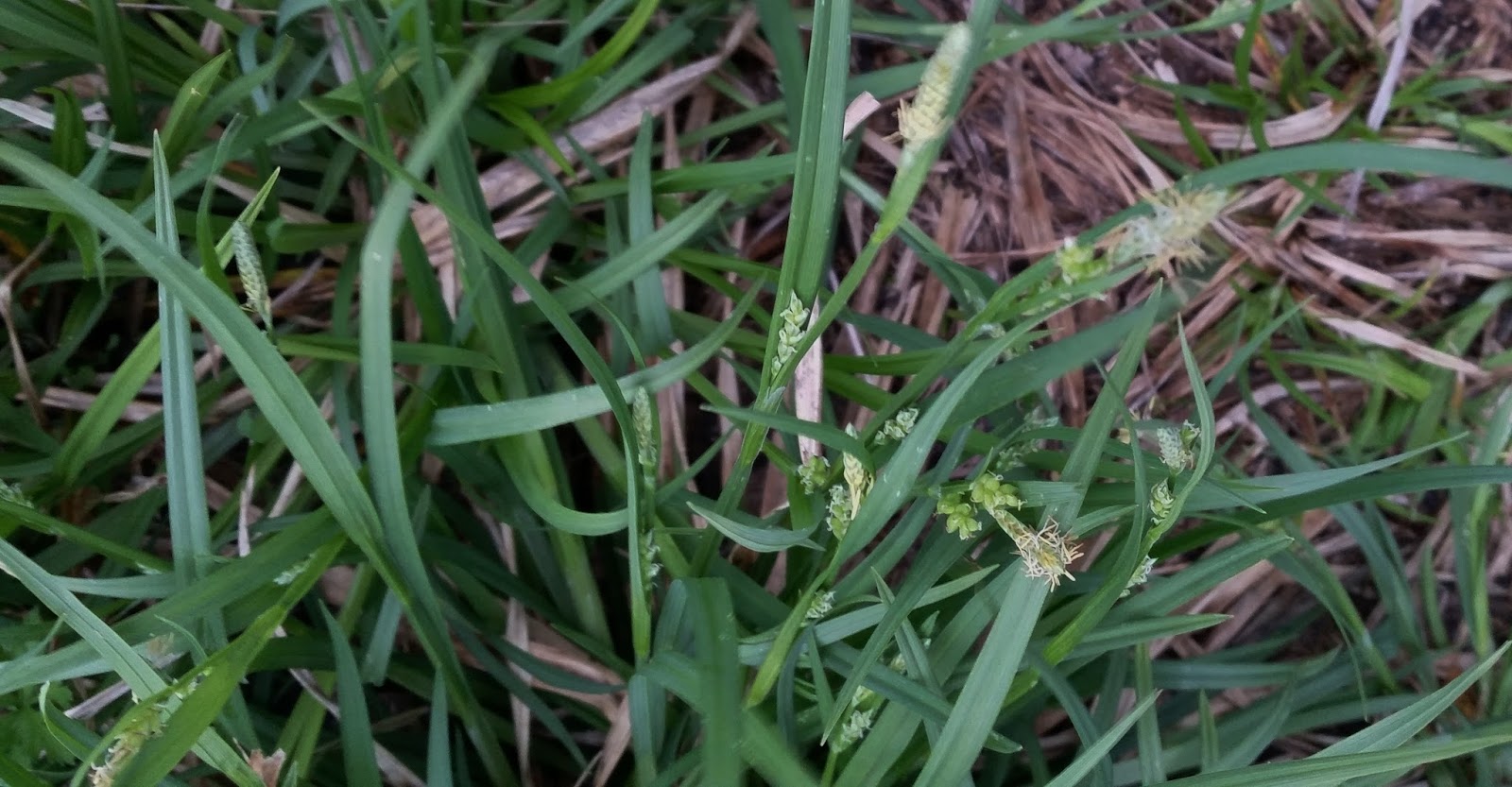
Carex Blanda, Creek Field, Volunteer
Ohio Buckeye, Riparian Buffer, Volunteer

Stellaria media Common Chickweed
Non-native
Pink Family
on creek bank
Volunteer!


Hedge Parsley, Torilis arvensis, Non-native annual,
Volunteer
This photo was taken in March 2016.   I'm including it here because I don't have a photo of it
from April 2015, but it was all over the Creek Field like a carpet in April 2015.
It came up just like this, green through the dead stalks of last year's growth.     
It is important, because every perennial that came up in the Creek Field had to push Hedge Parsley aside.
The ability of perennials to do exactly that is a source of great joy!


Friday, February 12, 2016

New Species for Bird Runner! Red Osier Dogwood

Thanks to Al Alspach, who spotted this variety of dogwood, Cornus sericea, a new species for us at Bird Runner!    Al saw it along our stretch of McDowell Creek, next to the Creek Field.   I had seen it, too, but assumed it was Rough-leaved Dogwood with unusually red stems!  
Al identified it for us.  It is a native species, widespread in North America.  It is also known (for obvious reasons) as Red-twig Dogwood, Red-stem Dogwood, & Red Willow.   Consistent with where we found it, it is also called Creek Dogwood.


I am eager to see it when it blooms--and then compare it to Rough-leaved Dogwood.  One more thing to look forward to this spring!